Milan, Italy – The International Ice Hockey Federation (IIHF) officially announced on Monday, December 8, 2025, that the ice surfaces for the highly anticipated Milano Cortina 2026 Olympic Winter Games will not conform to typical NHL dimensions, confirming weeks of speculation surrounding the venues.
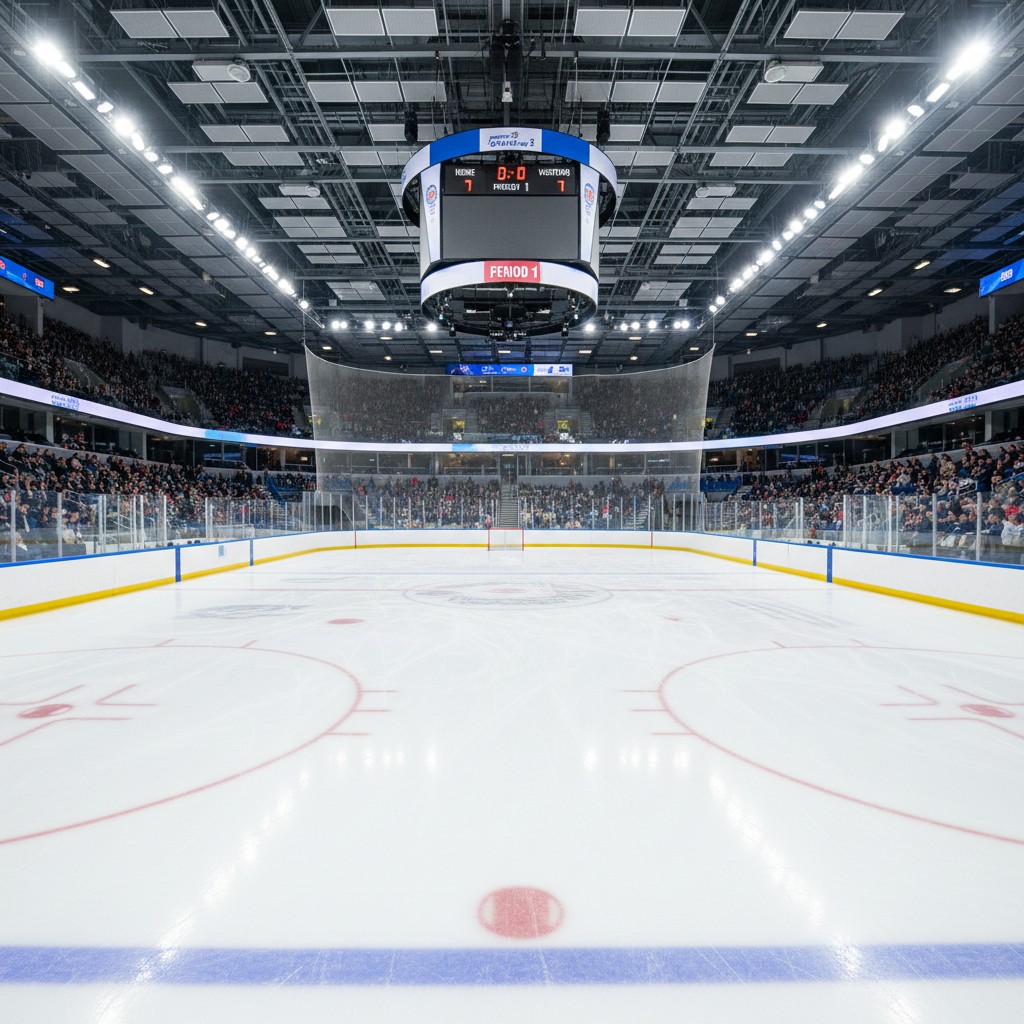
The confirmed dimensions for the Olympic rinks will be 60.0 meters by 26.0 meters, translating to approximately 196.85 feet in length and 85.3 feet in width. This contrasts with the standard NHL ice sheet, which measures 200 feet long by 85 feet wide. Consequently, the Olympic ice will be just over three feet shorter in length and marginally wider—by less than half a foot—than what professional players are accustomed to in North America.
This revelation comes as NHL players are set to return to the Olympic stage for the first time since the Sochi Games in 2014, making the conditions of play a significant point of discussion. The IIHF, in its statement, emphasized that these dimensions, while differing slightly from an NHL rink, are fully consistent with current IIHF regulations. Furthermore, the federation highlighted that the same rink size was utilized at the Beijing 2022 Olympic Winter Games and aligns with the specifications the NHL requires for its popular Global Series Games. As an example, the Pittsburgh Penguins and Nashville Predators recently competed on an identically sized ice surface during their Global Series matchups in Stockholm in November.
Stakeholders Agree on "Insignificant" Differences
Despite the deviation from NHL standards, the IIHF's statement conveyed a unified front among all key stakeholders. The federation asserted that "all involved, the IIHF, the Organizing Committee, NHL, NHLPA, IOC and the relevant venue authorities agree that the differences in rink specifications are insignificant, and should not impact either the safety or quality of game play." NHL Deputy Commissioner Bill Daly further corroborated this sentiment, indicating that both the NHL and the NHL Players' Association do not perceive the slightly smaller surface as a competitive disadvantage or a safety concern. Daly also referenced the positive feedback from players who recently participated in the Global Series games on a similar rink, noting no expressed concerns regarding the ice size.
The reasoning behind the altered dimensions appears to stem from the structural limitations of the Santa Giulia Ice Hockey Arena in Milan, the primary venue for both the men's and women's hockey tournaments. Reports indicate that the venue's design prevents organizers from adjusting the ice dimensions to a full NHL regulation size. While the initial agreement between the NHL, IIHF, and IOC reportedly stipulated NHL-regulation sheets, the final construction followed a different interpretation.
Player and Coaching Staff Reactions
While official bodies maintain that the impact will be minimal, some within the hockey community have voiced their perspectives. Finland men's hockey general manager Jere Lehtinen offered a pragmatic view, stating, "It's the same for every team, and I think that's the bottom line." However, Canadian star Nathan MacKinnon suggested that even subtle changes could be noticeable in game action. "If you have a foot less space it can be a big difference. If you get a foot closer in the slot, I think that could be a big difference. But it's the same for everybody," MacKinnon commented.
The issue was initially brought to light by Team Canada assistant coach Peter DeBoer, who, after visiting the site, expressed confusion about how the discrepancy arose. Despite his initial surprise, DeBoer also acknowledged that he didn't believe the difference would be "a huge difference."
Looking Ahead to Milano Cortina 2026
The 2026 Winter Olympics in February will feature hockey games played across two arenas. The Santa Giulia Ice Hockey Arena, a 16,000-seat facility, remains under construction, with crucial test events rescheduled for January 9-11. Organizers have stressed that there is "no Plan B" for the arena, underscoring the importance of these final preparations.
In anticipation of the Games, the NHL has reportedly dispatched personnel to Milan to provide assistance with the project, focusing on strategies to mitigate any potential impact of the slightly smaller playing surface, particularly in the neutral zone. Furthermore, looking beyond 2026, NHL Deputy Commissioner Bill Daly has already indicated that the league is pushing for proper rink sizes to be confirmed for the 2030 Games to prevent similar situations in the future.
The upcoming Olympics will mark a significant return for NHL talent, and while the ice dimensions have become a talking point, the focus remains on delivering a "best-on-best competition" for hockey fans worldwide.