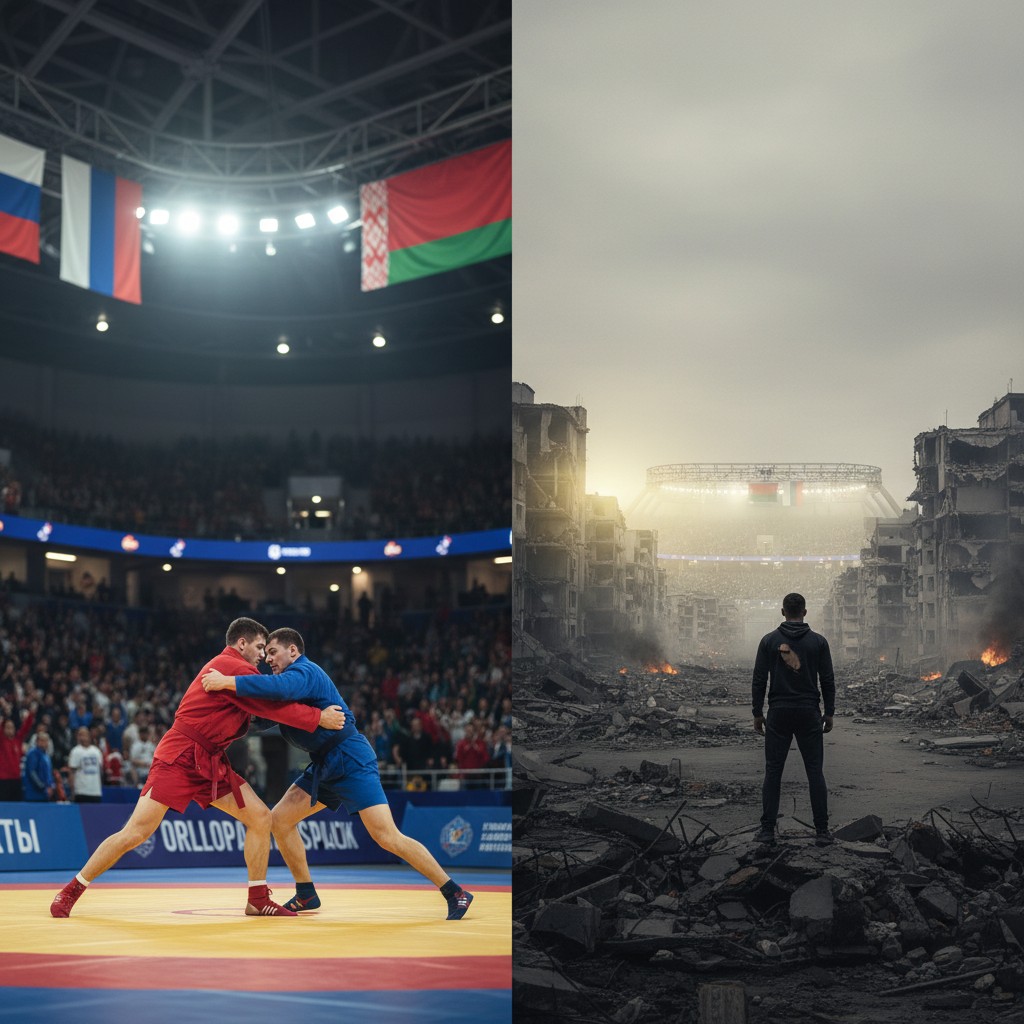
In a move that has ignited a fierce debate across the international sports landscape, the International Sambo Federation (FIAS) has announced the full reinstatement of Russian and Belarusian athletes to its competitions, allowing them to compete under their national flags and anthems starting January 1, 2026. This decision, following a similar lifting of sanctions by the International Judo Federation, has been met with strong condemnation from the Ukrainian World Congress (UWC), which argues that such actions legitimize the aggressor states' propaganda amidst the ongoing war in Ukraine.
FIAS Cites "Sport is Apolitical" Stance
The International Sambo Federation's Executive Committee, meeting on December 4, 2025, decided to extend the right to compete under national symbols to all age categories of Russian and Belarusian athletes. This builds upon a previous decision made on October 3, 2025, which had already allowed junior and youth athletes to compete under their national flags. Since Russia's full-scale invasion of Ukraine in 2022, FIAS had previously permitted athletes from both nations to compete only under a neutral status, a less stringent restriction compared to outright bans imposed by many other international sports organizations.
FIAS President Vasily Shestakov, who is also a member of the pro-Putin Russian party United Russia, articulated the federation's rationale. He stated, "Sport is a bridge for dialogue and mutual understanding between peoples, even in difficult times." Shestakov further emphasized that this decision "returns the situation to the legal framework based on equal rights for all members of our federation." This sentiment underscores FIAS's long-held belief that sports should remain separate from politics. The International Judo Federation had made a comparable decision on November 27, 2025, also removing all sanctions against Russian athletes.
Ukrainian World Congress Voices Strong Opposition
The Ukrainian World Congress, however, has vehemently rejected the notion of sports being apolitical in the current geopolitical climate. The UWC issued a strong statement condemning FIAS's decision, asserting that allowing Russian and Belarusian athletes to fully participate in international competitions "effectively legitimizes the propaganda of the aggressor states."
"Sport cannot be 'apolitical' while Russia continues its war against Ukraine and uses sports as a tool for influence and manipulation," the UWC stressed. They argue that such decisions by international federations "ignore the crimes of the aggressor and undermine global efforts to hold Russia accountable for its war mongering."
The UWC's position reflects a broader Ukrainian stance that views the reintegration of Russian and Belarusian athletes, especially under national symbols, as a direct affront to the victims of the conflict.
Ukraine's Broader Call for Continued Sanctions
The condemnation from the UWC is echoed by top Ukrainian officials and representatives on the international stage. Matviy Bidnyi, Ukraine's Youth and Sports Minister, recently stated that it is "too early" to discuss the return of Russian and Belarusian athletes under their national flags for events like the upcoming Winter Olympics. Bidnyi emphasized that a "strong ceasefire" must be agreed upon and seen in practice, alongside the allocation of funds for Ukraine's reconstruction, before any negotiations for reintegration could commence.
At the United Nations General Assembly, Dmytro Tymoshenko, First Secretary of Ukraine's Permanent Mission, underscored the devastating impact of Russia's aggression on Ukrainian sports. He highlighted that Moscow's actions have "disrupted the training of Ukrainian athletes, led to the cancellation or postponement of numerous events, restricted access to training facilities and caused the partial or complete destruction of sports infrastructure." According to the Ukrainian Ministry of Sport, approximately 800 sports facilities across the country have been damaged since the full-scale invasion began in 2022, with 180 completely destroyed. Tragically, at least 644 members of Ukraine's sports community have been killed, with 20 injured, 20 in captivity, and 13 missing.
Tymoshenko urged the international community to "maintain the suspension of Russian and Belarusian athletes from international sports competitions," arguing that allowing their delegations would "undermine the integrity of sport as a contributor to peace" and would "effectively signal silent approval of the killings of Ukrainian athletes." He pointed out that Ukraine, "the only country in history that, under full-scale attack, continues to send its national team to the Olympic Games," demonstrates its commitment to peace, dignity, and justice.
The Complexities of International Sports Governance
While some federations like FIAS and the International Judo Federation move towards reinstatement, the broader landscape of international sports governance remains complex. The International Olympic Committee (IOC) Executive Board, for instance, suspended Russia's Olympic Committee in October 2023 for breaching the Olympic Charter by integrating regional sports organizations in occupied Ukrainian territories. For the recent Paris Olympic Games, Russian and Belarusian athletes were only permitted to participate as "Individual Neutral Athletes" (AINs) by invitation from the IOC, and not under their national flags. Athletes who actively supported the invasion were also barred.
The varying approaches by different international sports bodies highlight the deep divisions and ethical dilemmas faced by the global sporting community. The UWC and Ukrainian officials consistently argue that until Russia ceases its aggression and is held accountable, the principle of "sport is apolitical" cannot genuinely apply, especially when the war directly impacts athletes and infrastructure. The decisions by FIAS and the International Judo Federation mark a significant step towards the reintegration of Russian and Belarusian athletes, but one that is met with profound opposition from those directly affected by the ongoing conflict.